 |
 |
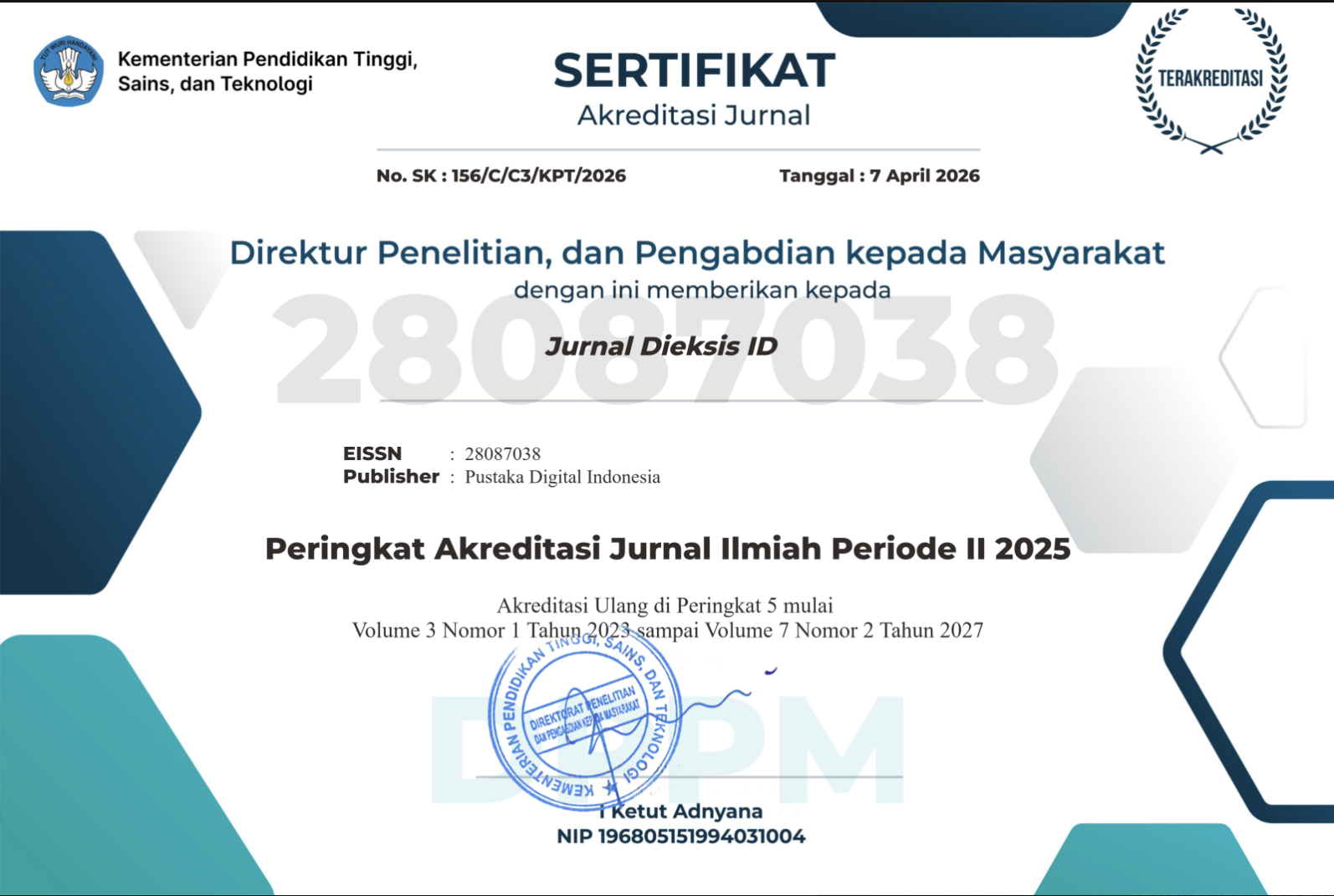
Jurnal DIEKSIS resmi terakreditasi SINTA 5 berdasarkan Surat Keputusan Direktur Jenderal Riset dan Pengembangan Nomor 156/C/C3/KPT/2026 tanggal 7 April 2026.
 |
 |

|
|
 |
 |

 |
|
|
 |

 |

|
Pustaka Digital Indonesia: Jurnal Dieksis ID adalah jurnal yang ditinjau oleh rekan sejawat yang dikelola oleh Pustaka Digital Indonesia. Pernyataan ini menjelaskan perilaku etis dari semua pihak yang terlibat dalam proses penerbitan sebuah artikel di jurnal ini, termasuk penulis, penyunting kepala, dewan redaksi, reviewer sejawat, dan penerbit. Pernyataan ini didasarkan pada Pedoman Praktik Terbaik COPE untuk Editor Jurnal. Pedoman Etika untuk Publikasi Jurnal Publikasi artikel dalam PUSTAKA DIGITAL INDONESIA: Jurnal Dieksis ID yang ditinjau oleh rekan sejawat merupakan blok bangunan penting dalam pengembangan jaringan pengetahuan yang koheren dan dihormati. Hal ini merupakan refleksi langsung dari kualitas karya penulis dan lembaga yang mendukung mereka. Artikel yang ditinjau oleh rekan sejawat mendukung dan mewujudkan metode ilmiah. Oleh karena itu, penting untuk menetapkan standar perilaku etis yang diharapkan bagi semua pihak yang terlibat dalam proses penerbitan, yaitu penulis, penyunting jurnal, reviewer sejawat, penerbit, dan masyarakat. Pustaka Digital Indonesia: Jurnal Dieksis ID menjalankan tugas pengawasan pada semua tahap penerbitan dengan sangat serius dan kami mengakui tanggung jawab etis dan lainnya. Kami berkomitmen untuk memastikan bahwa iklan, reprint, atau pendapatan komersial lainnya tidak memiliki dampak atau pengaruh pada keputusan editorial. Keputusan Publikasi Penyunting PUSTAKA DIGITAL INDONESIA: Jurnal Dieksis ID bertanggung jawab untuk memutuskan artikel mana yang akan dipublikasikan. Validasi karya yang dimaksud dan pentingnya bagi peneliti dan pembaca harus selalu mendorong keputusan semacam itu. Penyunting dapat dipandu oleh kebijakan dewan redaksi jurnal dan dibatasi oleh persyaratan hukum yang berlaku tentang pencemaran nama baik, pelanggaran hak cipta, dan plagiarisme. Penyunting dapat berdiskusi dengan penyunting atau reviewer lain dalam membuat keputusan ini. Fair Play Penyunting kapan saja mengevaluasi naskah untuk konten intelektualnya tanpa memandang ras, jenis kelamin, orientasi seksual, keyakinan agama, asal etnis, kewarganegaraan, atau filosofi politik penulis. Kerahasiaan Penyunting dan staf editorial tidak boleh mengungkapkan informasi tentang naskah yang dikirimkan kepada siapa pun selain penulis yang bersangkutan, reviewer, reviewer potensial, penasihat editorial lainnya, dan penerbit, sesuai dengan kebutuhan. Pengungkapan dan Konflik Kepentingan Materi yang belum dipublikasikan yang diungkapkan dalam sebuah naskah yang dikirimkan tidak boleh digunakan dalam penelitian sendiri penyunting tanpa persetujuan tertulis dari penulis. Setiap naskah yang diterima untuk ditinjau harus diperlakukan sebagai dokumen rahasia. Mereka tidak boleh ditunjukkan atau dibahas dengan orang lain kecuali yang diizinkan oleh penyunting. Tugas Reviewer Kontribusi pada keputusan editorial tinjauan sejawat membantu penyunting dalam membuat keputusan editorial dan melalui komunikasi editorial dengan penulis juga dapat membantu penulis dalam memperbaiki naskah. Ketepatan Waktu Setiap referee yang dipilih yang merasa tidak memenuhi syarat untuk meninjau penelitian yang dilaporkan dalam sebuah naskah atau tahu bahwa tinjauannya yang cepat akan menjadi tidak mungkin harus memberi tahu penyunting dan meminta maaf dari proses peninjauan. Standar Objektivitas Review harus dilakukan secara objektif. Kritik pribadi terhadap penulis tidak pantas. Referee harus menyatakan pandangannya dengan jelas dengan argumen pendukung. Pengakuan Sumber Reviewer harus mengidentifikasi karya yang dipublikasikan yang relevan yang belum dikutip oleh penulis. Setiap pernyataan bahwa sebuah pengamatan, derivasi, atau argumen telah dilaporkan sebelumnya harus disertai dengan kutipan yang relevan. Reviewer juga harus memberi tahu penyunting tentang adanya kesamaan atau tumpang tindih yang substansial antara naskah yang sedang dipertimbangkan dan naskah lain yang dipublikasikan yang mereka ketahui. Pengungkapan dan Konflik Kepentingan Informasi atau gagasan yang bersifat rahasia yang diperoleh melalui tinjauan sejawat harus dijaga kerahasiaannya dan tidak digunakan untuk keuntungan pribadi. Reviewer tidak boleh mempertimbangkan naskah di mana mereka memiliki konflik kepentingan yang timbul dari hubungan kompetitif, kolaboratif, atau lainnya dengan salah satu penulis, perusahaan, atau lembaga yang terhubung dengan naskah tersebut. Tugas Penulis Penulis laporan penelitian asli harus menyajikan akun yang akurat tentang pekerjaan yang dilakukan serta diskusi objektif tentang signifikansinya. Data yang mendasari harus diwakili secara akurat dalam naskah. Sebuah naskah harus mengandung detail dan referensi yang cukup untuk memungkinkan orang lain mereplikasi pekerjaan tersebut. Pernyataan yang menipu atau secara sadar tidak akurat merupakan perilaku tidak etis dan tidak dapat diterima. Akses Data dan Retensi Penulis diminta untuk menyediakan data mentah yang terkait dengan sebuah naskah untuk tinjauan editorial, dan harus siap untuk memberikan akses publik kepada data tersebut (sesuai dengan Pernyataan ALPSP-STM tentang Data dan Basis Data), jika memungkinkan, dan harus dalam setiap hal siap untuk menyimpan data tersebut untuk jangka waktu yang wajar setelah publikasi. Originalitas dan Plagiarisme Penulis harus memastikan bahwa mereka telah menulis karya yang benar-benar orisinal, dan jika penulis telah menggunakan karya dan/atau kata-kata orang lain, hal ini harus dikutip atau dikutip dengan benar. Publikasi yang ganda, redundan, atau bersamaan Seorang penulis tidak seharusnya, secara umum, memublikasikan naskah yang menggambarkan penelitian yang secara esensial sama di lebih dari satu jurnal atau publikasi utama. Mengirimkan naskah yang sama ke lebih dari satu jurnal secara bersamaan merupakan perilaku publikasi yang tidak etis dan tidak dapat diterima. Pengakuan Sumber Pengakuan yang tepat atas karya orang lain harus selalu diberikan. Penulis harus mengutip publikasi yang telah berpengaruh dalam menentukan sifat pekerjaan yang dilaporkan. Kepenulisan Naskah Kepenulisan harus dibatasi hanya kepada mereka yang telah memberikan kontribusi yang signifikan pada konsepsi, desain, pelaksanaan, atau interpretasi studi yang dilaporkan. Semua orang yang telah memberikan kontribusi yang signifikan harus tercantum sebagai penulis bersama. Jika ada orang lain yang telah berpartisipasi dalam aspek substansial tertentu dari proyek penelitian, mereka harus diakui atau tercantum sebagai kontributor. Penulis yang sesuai harus memastikan bahwa semua penulis bersama yang tepat dan tidak ada penulis bersama yang tidak tepat tercantum dalam naskah tersebut dan bahwa semua penulis bersama telah melihat dan menyetujui versi akhir naskah tersebut dan telah menyetujui untuk dipublikasikan. Bahaya dan Subjek Manusia atau Hewan Jika pekerjaan melibatkan bahan kimia, prosedur, atau peralatan yang memiliki bahaya yang tidak biasa yang melekat dalam penggunaannya, penulis harus dengan jelas mengidentifikasi ini dalam naskah. Pengungkapan dan Konflik Kepentingan Semua penulis harus mengungkapkan dalam naskah mereka setiap konflik kepentingan finansial atau substansial lainnya yang mungkin dianggap mempengaruhi hasil atau interpretasi naskah mereka. Semua sumber dukungan keuangan untuk proyek harus diungkapkan. Kesalahan Mendasar dalam Karya yang Diterbitkan Ketika seorang penulis menemukan kesalahan atau ketidakakuratan yang signifikan dalam karyanya yang telah diterbitkan, adalah kewajiban penulis untuk segera memberi tahu penyunting jurnal atau penerbit dan berkerjasama dengan penyunting untuk menarik kembali atau memperbaiki naskah tersebut. |
PUSTAKA DIGITAL INDONESIA: Dieksis ID Journal is a peer-reviewed journal managed by Pustaka Digital Indonesia. This statement clarifies the ethical behaviour of all parties involved in the act of publishing an article in this journal, including the author, the chief editor, the editorial board, the peer reviewer and the publisher. This statement is based on COPE’s Best Practice Guidelines for Journal Editors. Ethical Guideline for Journal Publication The publication of an article in a peer-reviewed PUSTAKA DIGITAL INDONESIA: Dieksis ID Journal is an essential building block in the development of a coherent and respected network of knowledge. It is a direct reflection of the quality of the work of the authors and the institutions that support them. Peer-reviewed articles support and embody the scientific method. It is therefore important to agree upon standards of expected ethical behaviour for all parties involved in the act of publishing, the author, the journal editor, the peer reviewer, the publisher, and the society. Pustaka Digital Indonesia: Dieksis ID Journal takes its duties of guardianship over all stages of publishing extremely seriously and we recognize our ethical and other responsibilities. We are committed to ensuring that advertising, reprint or other commercial revenue has no impact or influence on editorial decisions. We will assist in communications with other journals and/or publishers where this is useful and necessary. Publication Decisions The editor of PUSTAKA DIGITAL INDONESIA: Dieksis ID Journal is responsible for deciding which of the articles submitted to the journal should be published. The validation of the work in question and its importance to researchers and readers must always drive such decisions. The editors may be guided by the policies of the journal's editorial board and constrained by such legal requirements as shall then be in force regarding libel, copyright infringement, and plagiarism. The editors may confer with other editors or reviewers in making this decision. Fair play An editor at any time evaluates manuscripts for their intellectual content without regard to race, gender, sexual orientation, religious belief, ethnic origin, citizenship, or political philosophy of the authors. Confidentiality The editor and any editorial staff must not disclose any information about a submitted manuscript to anyone other than the corresponding author, reviewers, potential reviewers, other editorial advisers, and the publisher, as appropriate. Disclosure and Conflicts of Interest Unpublished materials disclosed in a submitted manuscript must not be used in an editor's own research without the express written consent of the author. Any manuscripts received for review must be treated as confidential documents. They must not be shown to or discussed with others except as authorized by the editor. Duties of Reviewers Contribution to editorial decisions peer review assists the editor in making editorial decisions and through the editorial communications with the author may also assist the author in improving the paper. Promptness Any selected referee who feels unqualified to review the research reported in a manuscript or knows that its prompt review will be impossible should notify the editor and excuse himself from the review process. Standards of Objectivity Reviews should be conducted objectively. Personal criticism of the author is inappropriate. Referees should express their views clearly with supporting arguments. Acknowledgement of Sources Reviewers should identify relevant published work that has not been cited by the authors. Any statement that an observation, derivation, or argument had been previously reported should be accompanied by the relevant citation. A reviewer should also call to the editor's attention any substantial similarity or overlap between the manuscript under consideration and any other published paper of which they have personal knowledge. Disclosure and Conflict of Interest Privileged information or ideas obtained through peer review must be kept confidential and not used for personal advantage. Reviewers should not consider manuscripts in which they have conflicts of interest resulting from competitive, collaborative, or other relationships or connections with any of the authors, companies, or institutions connected to the papers. Duties of Authors Authors of reports of original research should present an accurate account of the work performed as well as an objective discussion of its significance. Underlying data should be represented accurately in the paper. A paper should contain sufficient detail and references to permit others to replicate the work. Fraudulent or knowingly inaccurate statements constitute unethical behaviour and are unacceptable. Data Access and Retention Authors are asked to provide the raw data in connection with a paper for editorial review, and should be prepared to provide public access to such data (consistent with the ALPSP-STM Statement on Data and Databases), if practicable, and should in any event be prepared to retain such data for a reasonable time after publication. Originality and Plagiarism The authors should ensure that they have written entirely original works, and if the authors have used the work and/or words of others that this has been appropriately cited or quoted. Multiple, Redundant or Concurrent Publication An author should not, in general, publish manuscripts describing essentially the same research in more than one journal or primary publication. Submitting the same manuscript to more than one journal concurrently constitutes unethical publishing behaviour and is unacceptable. Acknowledgement of Sources Proper acknowledgement of the work of others must always be given. Authors should cite publications that have been influential in determining the nature of the reported work. Authorship of the Paper Authorship should be limited to those who have made a significant contribution to the conception, design, execution, or interpretation of the reported study. All those who have made significant contributions should be listed as co-authors. Where there are others who have participated in certain substantive aspects of the research project, they should be acknowledged or listed as contributors. The corresponding author should ensure that all appropriate co-authors and no inappropriate co-authors are included on the paper and that all co-authors have seen and approved the final version of the paper and have agreed to its submission for publication. Hazards and Human or Animal Subjects If the work involves chemicals, procedures or equipment that have any unusual hazards inherent in their use, the author must clearly identify these in the manuscript. Disclosure and Conflicts of Interest All authors should disclose in their manuscript any financial or other substantive conflicts of interest that might be construed to influence the results or interpretation of their manuscript. All sources of financial support for the project should be disclosed. Fundamental Errors in Published Works When an author discovers a significant error or inaccuracy in his/her own published work, it is the author’s obligation to promptly notify the journal editor or publisher and cooperate with the editor to retract or correct the paper. |
|
|
Jurnal DIEKSIS resmi terakreditasi SINTA 5 berdasarkan Surat Keputusan Direktur Jenderal Riset dan Pengembangan Nomor 156/C/C3/KPT/2026 tanggal 7 April 2026.
| |
|
|
|
|
|
| |
|
|
|
| |
Tim Redaksi Pustaka Digital Indonesia - Jurnal Dieksis ID
Kota Palopo - Sulawesi Selatan, Indonesia.
Email
pusdig.id@gmail.com
This is an open-access article distributed under the term Creative Commons International License.
This work is licensed under a Creative Commons Attribution 4.0 International license